Sensory Profiles and Sensory Processing
Ever feel like the world is turned up to eleven? The fluorescent lights at the supermarket buzz a little too loudly, a wool sweater feels like sandpaper, or a crowded room sends your nervous system into overdrive. Conversely, maybe you find yourself constantly pacing, tapping your foot, or needing deep pressure just to feel grounded.
If this sounds familiar, you are dealing with the intricate world of sensory processing.
Every single second, our brains are bombarded with data from the environment. How we take in, sort out, and respond to that data is completely unique to each individual. For neurodivergent individuals, particularly those navigating autism (ASD), attention deficit hyperactivity disorder (ADHD), or psychosocial disabilities, this filtering system operates on a totally different wavelength.
Understanding your unique sensory profile isn’t about finding a label; it’s about discovering a roadmap to a more comfortable, validating, and regulated life. Let’s break down how it all works.
What is Sensory Processing?
At its core, sensory processing is the method our nervous systems use to turn messages from our senses into adaptive behavioural and motor responses. Most of us were taught that we have five senses: sight, hearing, taste, touch, and smell. However, our brains actually track three additional internal senses that heavily impact our daily lives:
- Vestibular: Your sense of balance, spatial orientation, and movement.
- Proprioception: Your body awareness—knowing where your limbs are in space without looking at them.
- Interoception: Your internal body signals, like realising you are hungry, thirsty, tired, or need to use the restroom. This also includes the physical sensations of emerging emotions such as noticing changes in muscle tension, heart rate or breathing when our moods change.
When a person has an atypical profile, their brain registers these inputs differently than a neurotypical brain. They might experience sensory sensitivity (hyper-reactivity), where even a tiny bit of stimuli feels overwhelming, or sensory under-reactivity (hypo-reactivity), where they require much stronger stimuli to register the sensation.
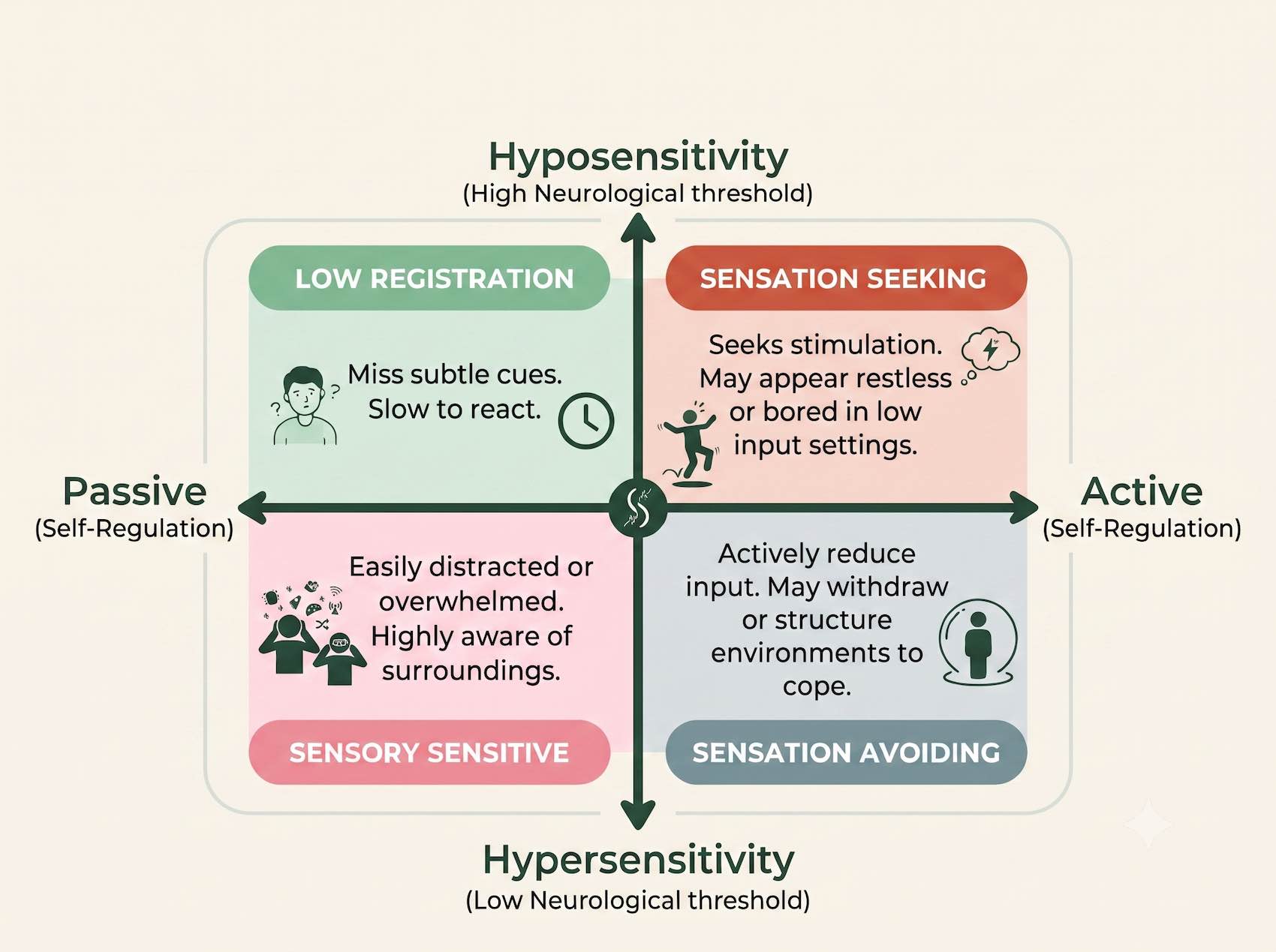
Decoding the Sensory Profile: The Four Core Patterns
A sensory profile is essentially a snapshot of how an individual reacts to the world around them. Developed by researcher Winnie Dunn, this framework categorises people into four primary quadrants based on their neurological thresholds and behavioural responses. Many people, especially those with a mix of ADHD and autism, find they have different patterns for different senses.
1. The Bystander (Low Registration)
People in this quadrant have a high neurological threshold. This means it takes a lot of input for their brain to notice something. Because their behavioural strategy is passive, they might not realise their environment is affecting them. They might miss someone calling their name, fail to notice they are bruised, or have a delayed reaction to pain. They might not smell things other people say they smell, or notice that they have food on their face or dirty hands.
2. The Seeker (Sensation Seeking)
Seekers also have a high threshold, but they actively pursue intense experiences to satisfy their brain’s hunger for input. You’ll often see this in children or adults who love spinning, crashing into things, listening to incredibly loud music, or constantly fidgeting. They can often be seen as loud or disruptive, labelled as a class clown or misbehaving because their need for sensory input leads to the distraction of others and themselves.
3. The Sensor (Sensory Sensitivity)
Sensors have a low neurological threshold, meaning they notice everything. This means a ticking clock or a tag on a shirt can be agonising. Because their strategy is passive, they tend to stay in the environment and internalise the discomfort. This often leads to emotional exhaustion, anxiety, or sudden meltdowns. Sensors may miss the words in a sentence because they are processing each syllable. They may miss the instructions in a paragraph because they are processing individual words. Or they may not see the forest for the trees, or rather, the bark on a tree.
4. The Avoider (Sensation Avoiding)
Avoiders have a low threshold but take an active approach to protect themselves. They will actively remove themselves from overwhelming situations. This looks like wearing noise-canceling headphones, refusing to go to busy places, or strictly sticking to safe, predictable routines and textures. Often demand avoidance has a root in sensory processing issues.
The Intersection of Neurodivergence and Sensory Needs
Atypical processing isn’t an isolated trait; it is deeply intertwined with neurodivergence. For parents, caregivers, and individuals themselves, recognising how these profiles show up in daily life is a game-changer.
Sensory Processing in Autism
For individuals on the autism spectrum, sensory differences are a core part of their lived experience. An autistic person might experience profound sensitivity to unpredictable environments, which can directly cause sensory overload. When the brain cannot process the influx of data, it triggers a fight, flight, or freeze response. This manifests as a meltdown (an outward explosion of distress) or a shutdown (an internal withdrawal). Conversely, repetitive behaviors like rocking or hand-flapping (stimming) are often functional tools used to self-regulate.
Sensory Processing in ADHD
While ADHD is primarily known for challenges with executive dysfunction and attention, sensory regulation is a massive piece of the puzzle. People with ADHD often struggle to filter out irrelevant sensory background noise. If an office is too loud or a room is too bright, their brain treats every single stimulus with equal importance. This makes concentration nearly impossible and can lead to quick irritability or burnout by the end of the day.

Practical Strategies for Creating a Sensory-Friendly Life
Once you identify where you or your child sits on the sensory spectrum, you can stop fighting your environment and start adapting it. Here are actionable strategies to build a lifestyle that supports your nervous system.
Accommodating Over-Reactivity (Sensory Avoiders & Sensors)
- Control the lighting: switch out harsh fluorescent bulbs for warm, indirect lighting or dimmable LEDs.
- Invest in sound management: high-quality loops, earplugs, or noise-canceling headphones can make public transit, supermarkets, and workplaces manageable.
- Curate a safe wardrobe: prioritise tagless, seamless clothing made from soft fabrics like bamboo or organic cotton.
- Create a reset space: dedicate a corner of your home as a “low-stim” zone with minimal visual clutter, soft pillows, and blackout curtains.
Supporting Under-Reactivity (Sensory Seekers & Low Registration)
- Incorporate “heavy work”: activities that push or pull against the body—like carrying groceries, doing push-ups, or using a weighted blanket—provide vital proprioceptive input.
- Use active seating: wobble stools, yoga balls, or resistance bands tied around chair legs allow for movement while working or studying.
- Introduce tactile fidgets: keep a variety of textures on hand, such as thinking putty, textured rings, or textured desk strips, to keep the brain engaged.
- Schedule movement breaks: If you have ADHD, set a timer for every 45 minutes to get up, stretch, spin, or pace to reset your focus.
The Path Forward: Validation Over Modification
For decades, traditional approaches mistakenly tried to force people with atypical profiles to mask their discomfort and tolerate distressing environments. Today, we know that true well-being comes from validating these differences.
If you are a parent or an individual navigating psychosocial disabilities, understanding these patterns allows you to stop viewing behaviour as “defiant” or “dramatic” and start seeing it as a direct communication of a nervous system need. By mapping out a clear sensory blueprint, you can build a world that accommodates, protects, and nurtures your unique mind and those around you.
If you’re looking to complete a sensory profile and learn more about how to manage your environment to work for you, reach out. We have a wealth of experience in delivering sensory assessments and working with people to develop plans to better navigate their unique sensory processing profile.
